Innovative coating systems
EUROPIPE and MÜLHEIM PIPECOATINGS have developed and tested new and innovative coating systems in collaboration with partners from industry and research. Our goal is to find the optimal coating for every medium, regardless of whether it is used to transport natural gas, hydrogen, CO2, salt water, or aggressive industrial water.
Industry 4.0
Coupling test rings
A destructive test is a test method in which the pipe is damaged or destroyed after the coating process in order to determine its physical properties such as hardness, tensile strength, or impact strength, or to verify the requirements of the coating on test plates in the laboratory.
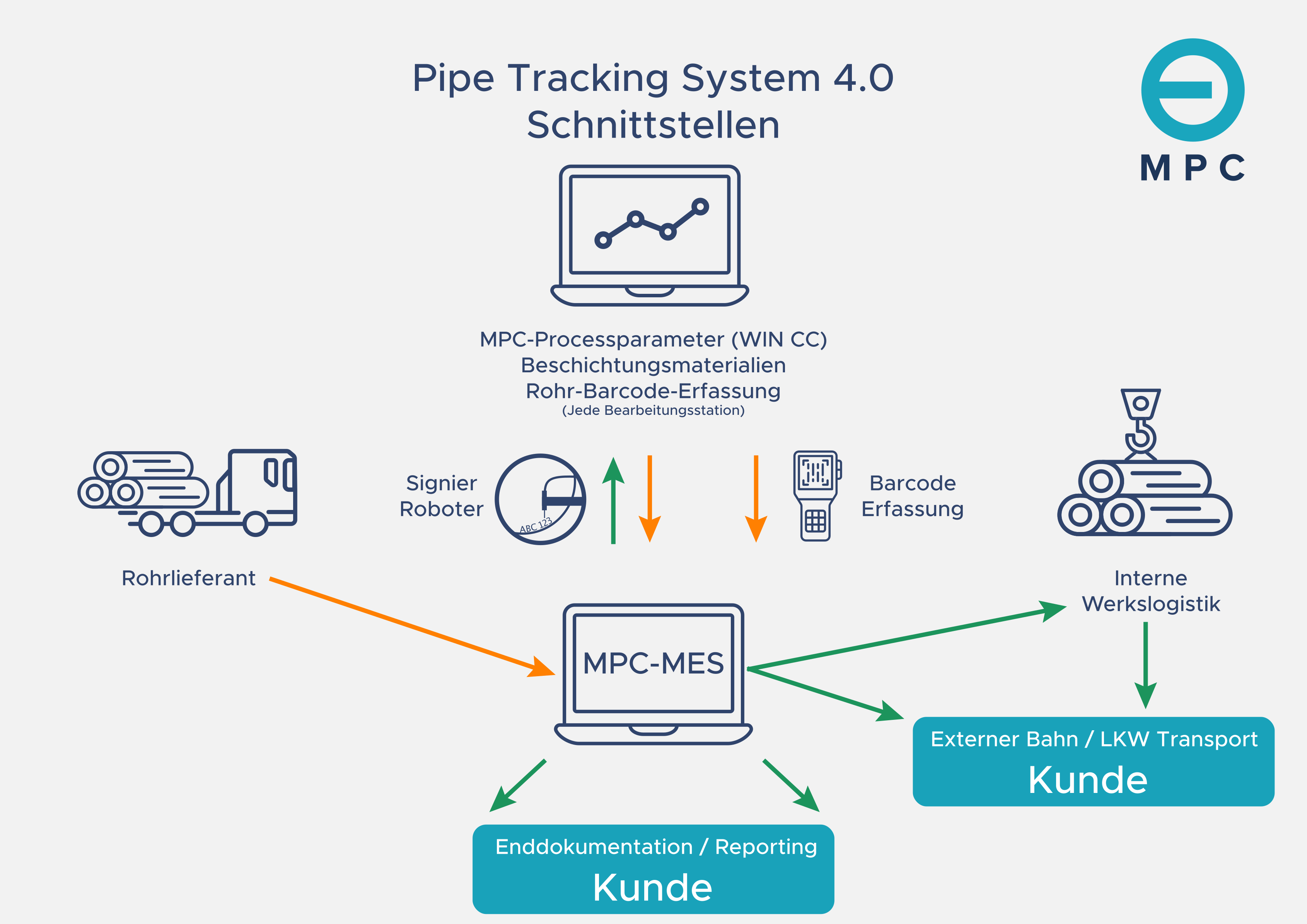
To avoid destructive testing on the finished product, MPC has developed and patented a process in which test rings made of the same material and with the same properties are coupled to a project pipe using specially designed pipe ring couplings. The pipe ring undergoes the coating process under the same process parameters and can be uncoupled after completion and used for destructive testing. This process reduces rework on project pipes and avoids the need to recoat the reworked pipe.
Coating of clad pipes
Clad pipes are plated pipes in which two different metals are joined together. This increases their resistance to corrosion and strength. The high-alloy inner layer serves to protect the outer substrate from the media being transported. A particular challenge is to ensure that the high-alloy pickled layer does not come into contact with other metals during the coating process.
To prevent this contact, MPC has designed its own blasting caps that seal the inner surface of the pipe during the blasting process and specially designed pipe couplings that leave no contact residues during the coating process. This further development ensures that the high-alloy pickled surface retains its origin.
Factory coating for pipes with different wall thicknesses (transition pipes)
Transition pipes are pipes with different wall thicknesses. In longer pipelines, the internal pressure is reduced, and with the reduction in pressure, it makes economic sense to reduce the wall thickness of the pipeline. Transition pipes are required to achieve the transition to the lower wall thickness. MPC has developed a process to compensate for differences in wall thickness within the factory coating using the same process parameters. This process reduces the effort required to re-insulate the circular seam and offers greater protection thanks to the factory coating.
Heat treatment
Heat treatment involves heating pipes for a limited time during the coating process. Here, the steel pipes are heated to specific temperatures, taking into account the heating and cooling rates to improve the material properties. (South Stream Project).